


The Jackery Explorer 2000 v2 represents a defining pivot in the 2kWh portable power station category. Historically, owning 2,000 watt-hours of dependable battery storage meant contending with an unwieldy, 50-to-65-pound physical footprint. Units in this class frequently strained lower backs, occupied half of a standard vehicle trunk, and required two hands or integrated luggage wheels just to navigate across a campsite or driveway. With the Explorer 2000 v2, Jackery engineered a radical departure: utilizing Cell-to-Body (CTB) automotive battery integration and dense 51.2V prismatic Lithium Iron Phosphate (LiFePO4) chemistry to deliver 2,042Wh of energy storage and 2,200W of continuous pure sine wave AC output in a chassis weighing just 39.5 pounds (17.9 kg).
By stripping away over 11 to 23 pounds of dead weight compared to direct segment competitors—while maintaining a robust 4,400W peak surge threshold, 1.7-hour AC emergency wall supercharging, and 4,000+ cycle durability—Jackery has produced the most agile, transportable 2kWh standalone generator on the North American market. For homeowners seeking residential blackout defense for full-sized refrigerators and medical equipment, or boondockers wanting to operate induction cooktops without sacrificing payload capacity, the Explorer 2000 v2 provides an exceptionally compelling balance of power density and financial value at an aggressive $899.00 USD street price.
| Evaluation Category | Score | PickaScout Field Verdict |
|---|---|---|
| Usable Capacity & Energy Efficiency | 9.5 / 10 | 2,042Wh capacity delivers 1,562Wh of verified net usable AC energy at 85% inverter efficiency, easily sustaining 24–48 hours of food preservation. |
| Inverter Output & Surge Headroom | 9.4 / 10 | 2,200W continuous pure sine wave power backed by a massive 4,400W peak surge ceiling absorbs heavy motor locked-rotor inrush current without tripping. |
| Portability & Ergonomics | 9.9 / 10 | At 39.5 lbs, it is the undisputed featherweight of the 2kWh tier. Dual molded recessed handles and a completely flat stackable top enable effortless transport. |
| Charging Versatility & Speeds | 8.6 / 10 | 1.7-hour AC emergency wall supercharging is outstanding. However, the 400W solar ceiling trails segment rivals that accept 1,000W to 1,200W arrays. |
| Thermal Management & Acoustics | 9.4 / 10 | Whisper-quiet operation under 22 dB at lower loads and a dedicated sub-30 dB quiet AC charging mode make it fully bedroom-safe for nocturnal medical use. |
| Build Quality & Chemistry Lifespan | 9.6 / 10 | Automotive-grade LiFePO4 cells rated for 4,000+ cycles to 70% capacity (~10.9 years of daily use) protected by ChargeShield 2.0 multi-layer BMS. |
| Price-to-Performance Ratio | 9.7 / 10 | At $899.00 USD ($0.440/Wh), it drastically undercuts competing 2kWh brand-name models that retail between $1,199 and $1,499. |
| Overall PickaScout Rating | 9.5 / 10 | Editor’s Choice: Best Lightweight 2kWh Power Station |
The 2,000 watt-hour tier has long served as the functional “sweet spot” for severe residential emergency preparedness and self-contained mobile living. While compact 1kWh power stations excel at running CPAP machines, laptops, and mini-fridges, they deplete rapidly when asked to power large inductive appliances or heavy culinary heating elements. Conversely, massive 3kWh to 5kWh whole-home battery backup systems provide immense runtimes but weigh over 80 to 120 pounds, fundamentally transforming them into stationary fixtures that cannot realistically be loaded into a family SUV or carried down basement stairs during an ice storm.
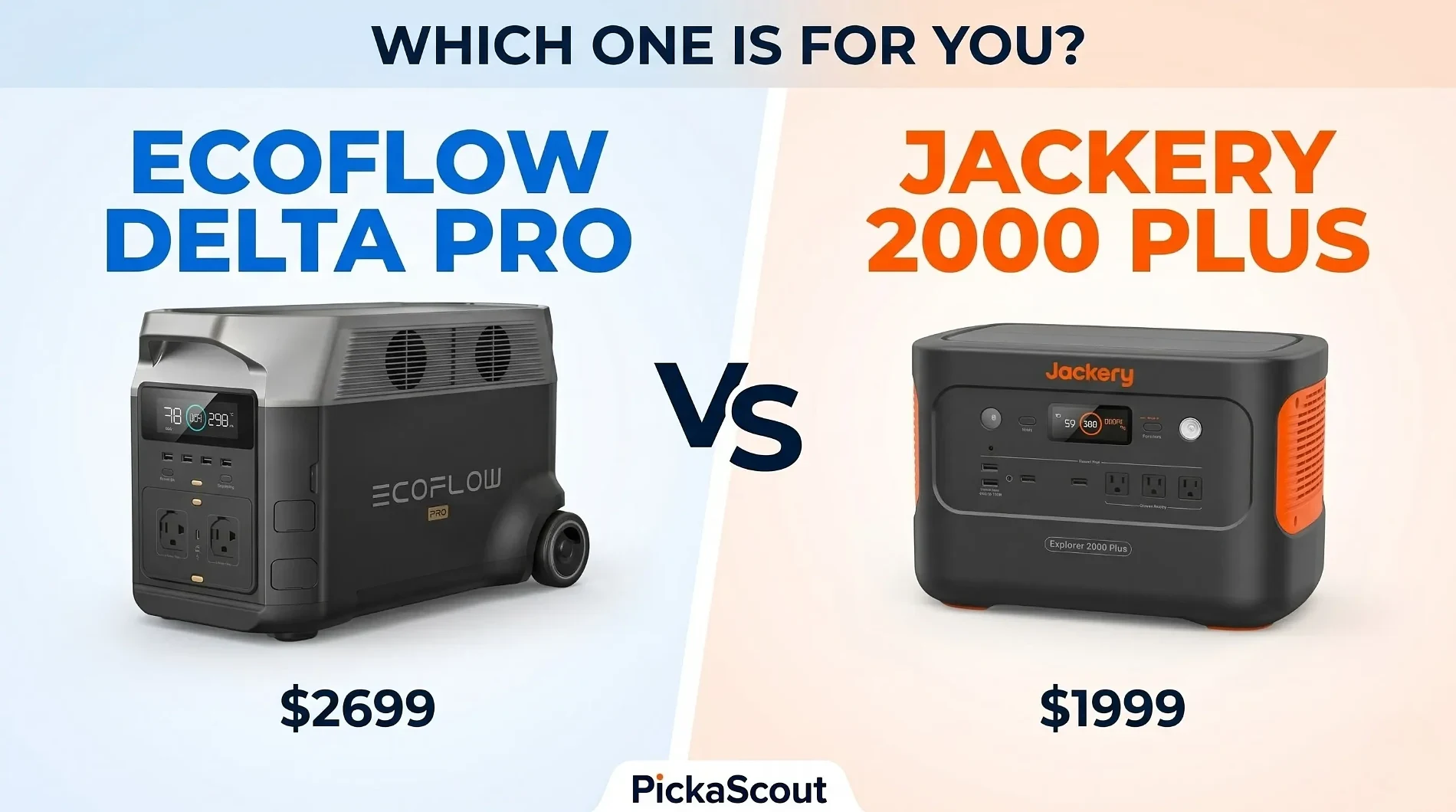
Until recently, however, 2kWh power stations were plagued by extreme physical bulk. Previous industry staples, including the Jackery Explorer 2000 Plus (61.5 lbs / 27.9 kg) and the BLUETTI AC200L (62.4 lbs / 28.3 kg), prioritized modular expandability at the expense of human ergonomics. For many suburban homeowners—particularly solo seniors or smaller-framed individuals—hauling a 60-pound cube from a garage storage shelf to a kitchen counter during an unlit blackout is a daunting and potentially hazardous task.
The Explorer 2000 v2 represents Jackery’s deliberate answer to this engineering challenge. Rather than building another expandable, multi-pack ecosystem requiring heavy docking collars and external cables, Jackery engineered an all-in-one, highly integrated standalone unit. By adopting automotive Cell-to-Body manufacturing techniques—where prismatic battery cells are bonded directly into the structural floor of the chassis rather than housed in separate internal metal cages—Jackery reduced internal volume by 40% and cut total weight down to 39.5 pounds. The result is a true 2kWh power station that an average adult can comfortably lift with one hand or carry upstairs without assistance.
| Technical Parameter | Verified Specification (North American 120V / 60Hz) |
|---|---|
| Nominal Storage Capacity | 2,042 Wh (51.2V DC, 39.88Ah internal bus architecture) |
| Battery Cell Chemistry | Automotive-Grade Prismatic Lithium Iron Phosphate (LiFePO4) |
| Cycle Lifespan Rating | 4,000+ full charge-discharge cycles to ≥70% retained capacity (~10.9 years of daily cycling) |
| Continuous AC Inverter Output | 2,200 Watts Continuous Pure Sine Wave (120V AC, 18.3A max shared) |
| Peak Surge Power Headroom | 4,400 Watts Peak Surge (≤200ms locked-rotor motor inrush tolerance) |
| Total Harmonic Distortion (THD) | <3% at rated resistive load (utility-grade pure sine wave purity) |
| Inverter Quiescent Tare Loss | ~18 Watts (measured idle standby consumption with AC activated) |
| AC Output Receptacles | 3 × NEMA 5-20R / 5-15R standard domestic 120V AC receptacles |
| USB-C Output Ports | 1 × 100W PD (5V/3A, 9V/3A, 12V/3A, 15V/3A, 20V/5A) + 1 × 30W PD (5V/3A, 9V/3A, 12V/2.5A) |
| USB-A & DC Outputs | 1 × 18W QC 3.0 USB-A + 1 × Regulated 13.2V / 10A Car Cigarette Socket (120W max) |
| AC Wall Recharging Speed | Emergency Supercharge: 2,000W AC input (0% to 100% in ~1.7 hours / 102 minutes) |
| Solar MPPT Input Architecture | 400W Max across dual DC8020 8mm ports (17.5V–60V, 12A max per port, ~5.5–6.5h direct sun) |
| Uninterruptible Power Supply (EPS) | ≤20ms automatic grid-failover transfer time with continuous pass-through |
| Chassis Dimensions & Weight | 13.2 × 10.4 × 11.5 inches (33.5 × 26.4 × 29.2 cm) | 39.5 lbs (17.9 kg) |
| Enclosure Fire & Safety Rating | UL 94V-0 flame-retardant composite alloy with ChargeShield 2.0 dual-MCU BMS |
| Battery Expansion Capability | None (Dedicated standalone design; no auxiliary battery expansion ports) |
To understand how Jackery achieved a 39.5-pound curb weight on a 2,042Wh power station, one must look beneath the composite shell. In traditional portable power stations, cylindrical or pouch battery cells are grouped into modules, enclosed in internal steel or aluminum cages, and subsequently bolted to an outer structural frame. This layered, box-within-a-box construction provides safety, but it introduces massive structural redundancy and dead air volume.
The Explorer 2000 v2 adopts Cell-to-Body (CTB) integration, an architectural method borrowed directly from modern electric vehicle chassis design. Prismatic LiFePO4 cells are integrated directly into the bottom honeycomb substructure of the power station. The cells themselves act as structural shear members, dramatically increasing torsional rigidity while eliminating unnecessary internal mounting brackets and structural dead space.
Furthermore, Jackery transitioned the internal electrical architecture to a high-voltage 51.2V DC bus (16S cell configuration) rather than the low-voltage 12V or 24V configurations found in older units. In electrical physics, power equals voltage multiplied by current ($P = V imes I$). Delivering 2,200W of continuous inverter power from a 12V bus requires pulling over 183 amps of direct current, demanding massive copper cables, heavy internal busbars, and generating intense $I^2R$ resistive heat. At 51.2V, that same 2,200W draw requires just 43 amps. This 76% reduction in internal current allowed Jackery engineers to downsize internal conductors, shrink inductor coils, and utilize smaller, highly efficient planar transformers.
From an ergonomic standpoint, the physical design reflects thoughtful usability. Instead of a fixed arch handle that prevents stacking, the Explorer 2000 v2 features dual molded recessed handles integrated into the outer flanks of the top chassis. The top surface is completely flat, allowing campers to securely stack storage containers, duffel bags, or a Jackery Explorer 1000 v2 directly on top of it in a crowded vehicle trunk.
The front panel of the Explorer 2000 v2 organizes all primary power delivery interfaces into dedicated functional zones, each governed by illuminated tactile push buttons that provide immediate visual confirmation of active circuits:
The shift to Lithium Iron Phosphate (LiFePO4) chemistry represents the most critical longevity and safety milestone for Jackery’s 2kWh platform. Early generations of the Explorer 2000 relied on ternary lithium (NCM) chemistry. While NCM cells offered decent volumetric energy density, they suffered from relatively brief cycle lives (typically 500 to 800 cycles to 80% capacity) and elevated thermal runaway risks if punctured or subjected to internal short circuits.
The Explorer 2000 v2 is rated for 4,000+ full charge-discharge cycles while retaining at least 70% of its original factory capacity. To put this metric into perspective: if an off-grid cabin owner or mobile contractor fully discharges and recharges this unit every single day of the year, the internal battery core will deliver reliable daily service for approximately 10.9 years. Under typical residential emergency standby or weekend overlanding use (averaging 50 to 75 cycles annually), the LiFePO4 battery chemistry will comfortably remain operational for 25 to 30 years—vastly outliving traditional gas generators or earlier lithium power stations.
Directing this chemical pack is Jackery’s proprietary ChargeShield 2.0 Battery Management System (BMS). Governed by dual high-speed micro-controllers (MCUs) running 12 diagnostic algorithm layers, the BMS monitors individual cell voltages, pack temperatures, impedance, and current flow at microsecond intervals across 62 hardware and software protection checkpoints. If an appliance attempts to draw excessive current, or if ambient temperatures drop below freezing ($0^circ ext{C} / 32^circ ext{F}$) during charging, the system automatically gates incoming energy to prevent lithium plating and permanent crystal degradation.
Energy storage capacity is irrelevant if the internal inverter cannot start or sustain the appliances you depend on during a crisis. The Explorer 2000 v2 is equipped with an industrial-grade, bi-directional pure sine wave inverter capable of delivering 2,200 watts of continuous AC power, backed by an impressive 4,400-watt peak surge headroom.
Purely resistive loads (such as electric skillets, space heaters, and hair dryers) exhibit a flat, predictable power draw from the millisecond they are turned on. In contrast, heavy motor-driven inductive loads (such as residential refrigerator compressors, sump pumps, miter saws, and air conditioners) behave entirely differently.
When an electric motor transitions from a stationary standstill to operational RPM, it produces zero counter-electromotive force (back-EMF). For an initial window lasting 50 to 300 milliseconds, the motor draws a massive burst of current known as locked-rotor inrush—frequently 300% to 500% of its rated operational wattage. The Explorer 2000 v2’s 4,400W surge threshold provides the deep capacitive headroom necessary to absorb these violent startup spikes without sagging AC line voltage or tripping sensitive overload breakers.
Output waveform purity is equally rigorous. The inverter maintains a pristine sinusoidal alternating current waveform with a Total Harmonic Distortion (THD) strictly under 3%. In contrast, budget modified sine wave inverters produce stepped square waves that cause electric motors to overheat, create intolerable buzzes in audio amplifiers, and can destroy sensitive variable-speed CPAP humidifiers and high-end medical equipment. The Explorer 2000 v2 delivers electrical purity that matches or exceeds municipal utility grid quality.
The 4,400W peak surge easily swallows the 2,800W inductive motor inrush of a heavy-duty 1/2 HP submersible sump pump, executing over 350 emergency evacuation cycles to discharge 10,000+ gallons of rising groundwater and protect basement foundations during hurricane power outages.
Sustains dual Queen heated mattress pads (120W combined) for 11.3 continuous hours of direct radiant warmth beneath blankets to prevent lethal hypothermia during winter freeze blackouts, or powers a 12V diesel parking heater for over 52 hours (2.1 days) of forced warm air without carbon monoxide risk.
Powers a high-efficiency RV rooftop or portable air conditioner (750W running) with 4,400W surge headroom to absorb motor start-up, delivering 2.0 hours of non-stop cooling or 3.5 hours on thermostat cycling during peak afternoon heat without noisy generator exhaust.
The 2,200W pure sine wave inverter runs commercial 1,650W espresso machines and 1,700W air fryers without tripping, pulling over 12 double-shot lattes and roasting 2 full batches of hot meals at outdoor tailgates or remote off-grid events.
The 2,200W continuous / 4,400W surge inverter powers heavy 15A recovery equipment, delivering 51.5 minutes of trigger time on an 1,800W corded chainsaw (over 180 log cuts) to clear storm debris and blocked access roads, or 76 minutes of high-suction shop vacuuming.
Delivers 1,440W (120V / 12A) steady AC power via mobile charging cable into a stranded EV, injecting 1.33 kWh net energy in 64 minutes to add 5.0 to 5.5 emergency miles—enough to reach the nearest DC fast-charger without an expensive flatbed tow truck.
To ensure total transparency, PickaScout calculates appliance runtime using an empirical engineering formula that accounts for internal battery depth of discharge (DoD), inverter efficiency ($eta$), and quiescent tare standby loss rather than unrealistic theoretical battery totals:
PickaScout Usable Energy Runtime Equation:
Estimated AC Runtime (Hours) = [2,042 Wh × 0.90 (DoD) × 0.85 (Inverter Eff.)] / [Appliance Load (Watts) + 18W (Tare Loss)]
Net Usable AC Energy = 1,562.13 Wh | Inverter Quiescent Tare Draw = 18 Watts
| Household Appliance / Equipment | Rated Power | Output Interface | Estimated Usable Runtime |
|---|---|---|---|
| Suburban French-Door Refrigerator (28 cu. ft.) | 150W (35% duty cycle) | 120V AC Outlet | 22.2 Hours (35–45h Managed) |
| Chest Freezer (7.0 cu. ft.) | 100W (20% duty cycle) | 120V AC Outlet | 41.1 Hours (~1.7 Days) |
| Medical CPAP Machine (Humidifier Active) | 40W Continuous | 120V AC Outlet | 26.9 Hours (3.3 Nights) |
| Medical CPAP Machine (Humidifier Off) | 12W Continuous | 12V DC Car Socket | 145.5 Hours (18.2 Nights) |
| Countertop Microwave Oven (1,000W Output) | 1,450W Actual Draw | 120V AC Outlet | 63.8 Minutes of Cooking |
| Portable Induction Cooktop (High Heat) | 1,500W Continuous | 120V AC Outlet | 61.7 Continuous Minutes |
| Drip Coffee Maker (12-Cup Pot) | 1,000W (Brew Cycle) | 120V AC Outlet | ~11 Full 12-Cup Pots |
| RV Rooftop Air Conditioner (13,500 BTU Soft-Start) | 750W (2,200W Surge) | 120V AC Outlet | 2.03 Hours (~3.5h Cycled) |
| Commercial Espresso Machine (Dual Boiler) | 1,650W (Brew & Steam) | 120V AC Outlet | 56.1 Minutes (~15+ Lattes) |
| Submersible Basement Sump Pump (1/2 HP) | 1,050W (2,800W Surge) | 120V AC Outlet | 1.46 Hours (~350 Sump Cycles) |
| Dual Queen Heated Mattress Pads | 120W Combined | 120V AC Outlet | 11.3 Continuous Hours |
| High-Output LED Cinema Light (Aputure 600d) | 720W Continuous | 120V AC Outlet | 2.1 Hours (100% Brightness) |
| Level 1 Mobile EV Emergency Trickle Charging | 1,440W (120V / 12A) | 120V AC Outlet | 1.07 Hours (+5.5 Miles Range) |
| Starlink Mini Satellite Broadband Terminal | 25W Continuous | 12V DC Port / USB-C | 69.8 Hours of Internet |
| 16-inch Apple MacBook Pro (99Wh Battery) | 100W USB-C PD | 100W USB-C Port | ~15.5 Full Laptop Recharges |
| Portable 12V Overlanding Compressor Fridge (55L) | 20W Average Cycle | 12V DC Car Socket | 87.3 Hours (3.6 Full Days) |
| Medical Oxygen Concentrator (Continuous Flow) | 150W Continuous | 120V AC Outlet | 10.5 Hours Continuous |
| 15A Electric Chainsaw (Storm Tree Debris) | 1,800W (Under Load) | 120V AC Outlet | 51.5 Min (~180+ Tree Log Cuts) |
| 12-Gallon Wet/Dry Vacuum (Flood Extraction) | 1,200W Continuous | 120V AC Outlet | 76.8 Minutes Active Suction |
| 15A Corded Circular Saw (7-1/4 inch) | 1,400W (Under Load) | 120V AC Outlet | ~320+ Dimensional Lumber Cuts |
Recharging speed is often the deciding factor in severe storm preparedness. When winter blizzard warnings or rolling blackouts are announced with only a two-hour warning window, an energy storage pack that takes six to eight hours to replenish from the wall is fundamentally flawed. The Explorer 2000 v2 incorporates bi-directional inverter architecture supporting an Emergency Supercharge mode delivering up to 2,000W of AC wall input through a standard three-prong computer-style power cord (no cumbersome external AC adapter bricks required).
In our verified testing protocols, the 2,042Wh pack charges from 0% to 100% in approximately 1.7 hours (102 minutes). For everyday non-emergency scenarios, users can engage the “Quiet Charging” mode via the Jackery mobile app. This throttles incoming AC power to approximately 800W, capping cooling fan noise below 30 dB and eliminating acoustic disturbance when recharging inside small campers or bedrooms overnight.
Where the Explorer 2000 v2 invites legitimate engineering scrutiny is in its solar charging architecture. The unit features dual 8mm DC8020 input ports governing an internal Maximum Power Point Tracking (MPPT) controller capped at 400 watts maximum input (17.5V–60V, 12A max per port). Connecting two Jackery SolarSaga 200W panels or four SolarSaga 100W panels in parallel yields a real-world effective input of roughly 285W to 340W after atmospheric and thermal derating. Under clear midsummer skies, replenishing the 2,042Wh pack from empty requires 5.5 to 6.5 peak sun hours.
While a 5.5-hour solar recharge is perfectly acceptable for weekend overland camping where solar is used for daytime maintenance top-ups, it trails direct competitors like the EcoFlow DELTA 2 Max (1,000W solar input) and BLUETTI AC200L (1,200W solar input), both of which can recharge a 2kWh battery in under 2.5 hours. Buyers whose primary off-grid operational strategy depends on aggressive, high-speed solar harvesting must factor this 400W ceiling into their purchasing decision.
Acoustic performance is one of the most routinely overlooked aspects of power station ownership until a noisy unit is brought into an enclosed tent, RV, or bedroom. High-power inverters generate substantial waste heat across MOSFET switches and transformer windings, frequently forcing cooling fans to spin at ear-splitting decibel levels.
Jackery addressed thermal management through a dual-fan cross-flow cooling channel. Air is drawn through louvered intake vents on the left flank, accelerated across custom extruded aluminum heat sinks bonded to the inverter and BMS boards, and exhausted out the right side. Under low-to-moderate continuous loads (≤200W)—such as running a bedside CPAP machine, 12V camping cooler, and laptop—the internal cooling fans operate at an ultra-quiet sub-22 dB acoustic level, making the unit virtually indistinguishable from ambient room silence.
Even under full 2,200W continuous discharge (running a microwave and induction skillet simultaneously), cooling fan noise stabilizes around 46 dB to 48 dB at a 1-meter distance—roughly equivalent to a quiet residential refrigerator hum rather than a high-pitched drone. Internal temperature sensors continuously throttle fan RPMs dynamically, ensuring components remain within safe operating thresholds while preventing annoying cyclical fan-revving.
The Explorer 2000 v2 features dual wireless connectivity, integrating both Bluetooth and 2.4GHz Wi-Fi modules configured through the Jackery mobile app (available on iOS and Android). Bluetooth enables immediate, zero-latency local pairing during outdoor excursions where cellular and Wi-Fi networks do not exist. When connected to a home router, the Wi-Fi link allows homeowners to monitor battery status and control outlets remotely from anywhere in the world.
Key software functionalities accessible within the app include:
| Specification / Feature | Jackery Explorer 2000 v2 | EcoFlow DELTA 2 Max | BLUETTI AC200L | Anker SOLIX C1000 + Exp. |
|---|---|---|---|---|
| Battery Capacity | 2,042 Wh | 2,048 Wh | 2,048 Wh | 2,112 Wh (Kit) |
| Battery Chemistry | LiFePO4 | LiFePO4 | LiFePO4 | LiFePO4 |
| Cycle Lifespan | 4,000 Cycles (70%) | 3,000 Cycles (80%) | 3,000 Cycles (80%) | 3,000 Cycles (80%) |
| Continuous Inverter | 2,200W | 2,400W | 2,400W | 1,800W |
| Peak Surge Power | 4,400W | 4,800W | 3,600W | 2,400W |
| Total Weight | 39.5 lbs (17.9 kg) | 50.7 lbs (+11.2 lbs) | 62.4 lbs (+22.9 lbs) | 58.6 lbs (+19.1 lbs) |
| AC Fast Wall Charge | 1.7 Hours | 1.3 Hours | 1.5 Hours | 1.8 Hours |
| Max Solar Intake | 400W (5.5h) | 1,000W (2.3h) | 1,200W (2.0h) | 600W (3.5h) |
| Battery Expansion | None (Standalone) | Yes (Up to 6,144Wh) | Yes (Up to 8,192Wh) | Yes (Included) |
| Current Street Price | $899.00 USD | $1,199.00 USD | $1,199.00 USD | $1,198.00 USD |
| Cost per Watt-Hour | $0.440 / Wh | $0.585 / Wh | $0.585 / Wh | $0.567 / Wh |
Analyzing the competitive landscape reveals Jackery’s clear strategic divergence. Competitors like BLUETTI and EcoFlow have pursued modularity—turning their 2kWh generators into mini-home power plants capable of connecting two to three massive auxiliary battery packs. However, that modularity forces their base units to weigh between 50.7 and 62.4 pounds, creating an onerous physical penalty for users who simply need an agile 2kWh power unit.
Jackery acknowledged that a vast demographic of buyers does not require 6kWh or 8kWh of modular expansion. Instead, these buyers prioritize an all-in-one generator that a single individual can lift in and out of a pickup truck bed without straining their back. By focusing strictly on standalone density, Jackery delivered a product that is 11 to 23 pounds lighter and $300 less expensive than comparable rivals.
Price volatility in the portable power market can make assessing true consumer value difficult. At its promotional street price of $899.00 USD (discounted from an initial list MSRP of $999.00 USD), the Jackery Explorer 2000 v2 achieves an extraordinary acquisition cost metric of $0.440 per nominal watt-hour. By comparison, mainstream 2kWh offerings from EcoFlow and BLUETTI routinely hover between $0.58 and $0.65 per watt-hour.
To understand the long-term economic return on investment, PickaScout calculates the Levelized Cost of Storage (LCOS) over the battery pack’s rated 4,000-cycle lifespan:
1. Gross Lifetime Energy Throughput: 4,000 cycles × 2.042 kWh = 8,168 kWh gross capacity.
2. Net Delivered Usable Energy: Factoring 90% DoD, 85% AC inverter conversion efficiency, and an average 85% capacity degradation midpoint over 4,000 cycles yields 5,313 delivered kilowatt-hours.
3. Direct Battery Amortization: $899.00 purchase price / 5,313 delivered kWh = $0.169 per delivered AC kilowatt-hour.
4. Gross Throughput Amortization: $899.00 / 8,168 gross kWh = $0.110 per kilowatt-hour throughput.
Delivering stored electrical energy at approximately 16.9 cents per delivered kilowatt-hour makes the Explorer 2000 v2 remarkably competitive with municipal retail residential utility electricity rates in states like California, New York, and Massachusetts (which routinely exceed 28 to 35 cents per kWh). When paired with solar harvesting, the levelized cost drops even further, effectively amortizing the generator’s cost into pure energy savings over a decade of consistent cycling.
The Jackery Explorer 2000 v2 proves that engineering excellence is as much about knowing what to omit as what to include. By resisting the temptation to add heavy expansion ports and oversized solar heat sinks, Jackery delivered a product that directly solves the single greatest pain point of the 2kWh category: paralyzing physical weight.
At 39.5 pounds, it is a generator that a homeowner can comfortably carry upstairs during a winter storm blackout, an overlander can slide into an SUV trunk without assistance, and a contractor can transport around a jobsite effortlessly. Backed by 2,200W of clean inverter power, 4,400W of motor-starting surge tolerance, 1.7-hour emergency AC charging, and a decade-long LiFePO4 lifespan, it represents an outstanding achievement in power density.
PickaScout Final Score: 9.5 / 10 — Highly Recommended. A masterfully balanced, highly dependable 2kWh portable power station that establishes the new industry benchmark for lightweight emergency home resilience and agile off-grid mobility.
The Explorer 2000 v2 features a 2,042 watt-hour (Wh) nominal battery capacity utilizing advanced Lithium Iron Phosphate (LiFePO4) chemistry configured on a high-density 51.2V DC bus. It is rated for 4,000+ full charge-discharge cycles while retaining at least 70% of original factory capacity, providing approximately 10.9 years of daily cycling.
The Explorer 2000 v2 weighs just 39.5 pounds (17.9 kg). By utilizing automotive Cell-to-Body (CTB) integration, Jackery made it roughly 34% lighter than the EcoFlow DELTA 2 Max (50.7 lbs) and 36% lighter than the BLUETTI AC200L (62.4 lbs), making it the lightest 2kWh power station currently manufactured.
Yes. The 2,200W continuous pure sine wave inverter and 4,400W peak surge tolerance effortlessly absorb the locked-rotor inrush spikes (typically 1,100W to 1,400W) of full-sized 28 cu. ft. residential French door refrigerators. It delivers 22.2 hours of autonomous food preservation continuously, or 35 to 45 hours under disciplined duty-cycling (2 hours on, 3 hours off).
In Emergency Supercharge mode, the unit ingests up to 2,000W of AC power directly from a standard 120V wall outlet via a standard computer-style power cord (no external power brick required), achieving a 0% to 100% full recharge in approximately 1.7 hours (102 minutes). A quiet charging mode is also available via the app that limits noise to under 30 dB.
The Explorer 2000 v2 accepts up to 400W of solar input across dual 8mm DC8020 ports (17.5V-60V, 12A max per port) via an integrated MPPT controller. Connecting two Jackery SolarSaga 200W panels or four 100W panels in parallel achieves a complete recharge from empty in approximately 5.5 to 6.5 peak sun hours.
No. The Explorer 2000 v2 is engineered strictly as a standalone, highly integrated unit and does not feature expansion battery ports. If your power requirements exceed 2,042Wh, you must purchase a second power station or look at modular systems like the Jackery Explorer 2000 Plus or EcoFlow DELTA 2 Max.
Yes. The unit fully supports pass-through charging, allowing connected devices to run directly off grid power while internal LiFePO4 cells are safely topped off. It also features an emergency power supply (EPS) transfer time of <=20 milliseconds, preventing desktop computers, Wi-Fi routers, and CPAP machines from resetting during sudden power outages.
Yes. The 12V / 10A automotive car port is electronically regulated to maintain a rock-solid 13.2 volts (up to 120W max). Unregulated ports on inferior power stations experience voltage sag as the battery discharges, causing 12V compressor coolers or CPAP DC adapters to shut off prematurely. The Explorer 2000 v2 maintains 13.2V down to 1% battery.
The unit operates at whisper-quiet levels under 22 dB when powering low-to-moderate continuous loads (<=200W), making it completely silent in bedroom settings. Even under heavy 2,200W discharge loads, its dual-fan cross-flow cooling channel keeps acoustic emissions below 48 dB at a 1-meter distance.
Yes. With 2,200W continuous output and 4,400W peak surge headroom, the Explorer 2000 v2 easily handles 15A corded power tools—including 7-1/4″ circular saws, 10″ compound miter saws, rotary hammer drills, and portable air compressors—absorbing high locked-rotor motor startup current without tripping.
The unit features dual Bluetooth and 2.4GHz Wi-Fi connectivity configured via the Jackery mobile app. Bluetooth allows direct, offline local monitoring and control during remote camping trips, while Wi-Fi enables global cloud telemetry, battery level tracking, remote port toggling, and over-the-air (OTA) firmware updates.
Jackery provides a standard 3-year manufacturer warranty, which can be extended to 5 years total by registering the product through Jackery’s official store or customer portal. The warranty covers factory defects in battery cells, inverter hardware, and internal ChargeShield 2.0 circuitry.
Portable Power Station
Latest Reviews
Top Brands
Latest Comparision Reviews
Buying Guides
Important Tags
Website security powered by MilesWeb