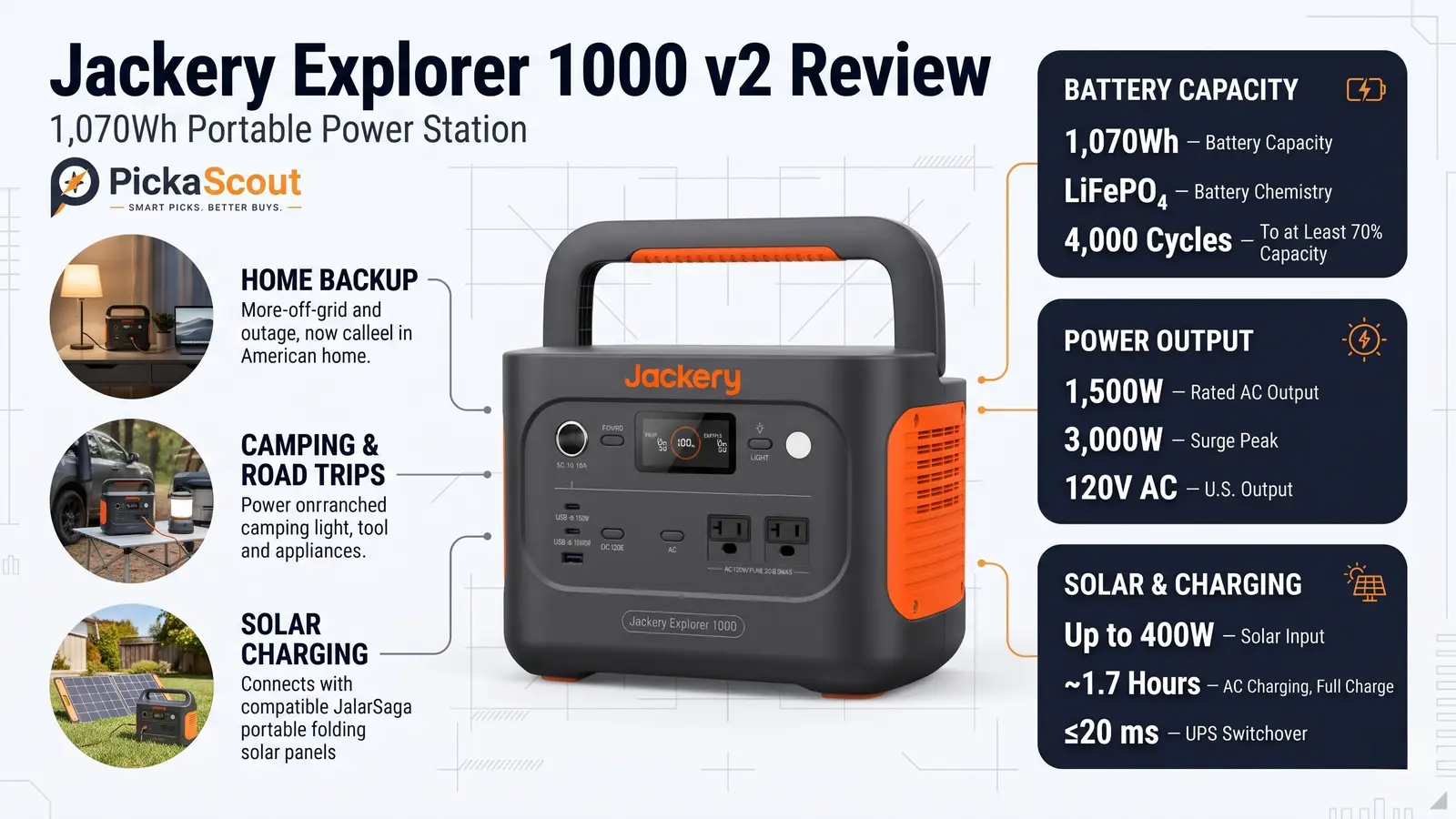


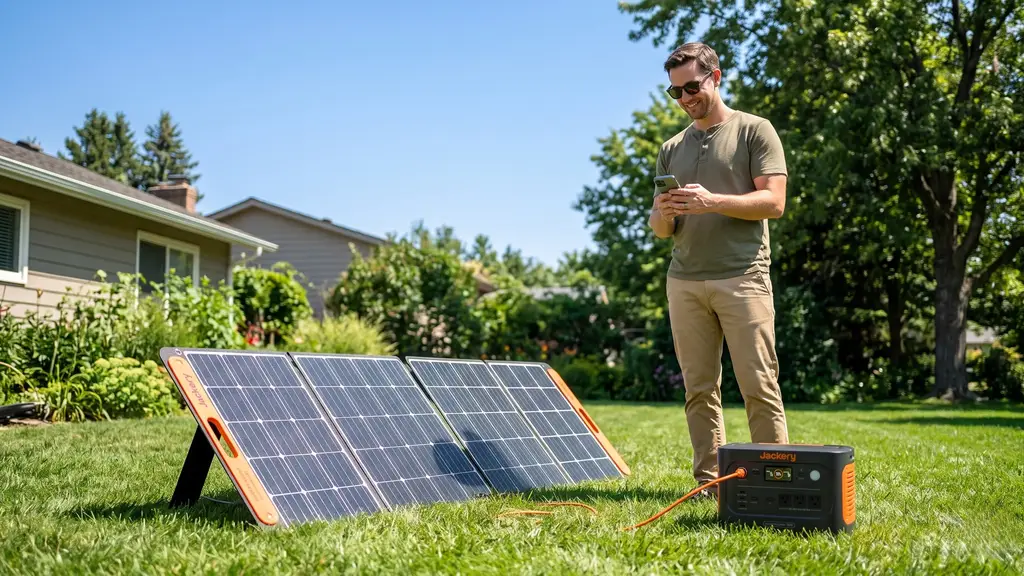
The Jackery Explorer 1000 v2 sets a new benchmark for portability and ergonomics in the competitive 1kWh power station category. Built with 1,070Wh of durable LiFePO4 cells rated for 4,000+ cycles and a 1,500W pure sine wave inverter (3,000W surge), it sheds unnecessary bulk to weigh just 23.8 pounds. Its flat fold-down handle stows completely flush, eliminating wasted vertical space in crowded vehicles. Featuring a rapid 60-minute Emergency Supercharge via a standard AC cord, whisper-quiet <22dB charging acoustics, and an accessible $499 direct street price, it is an exceptionally balanced choice for overland campers, CPAP sleep apnea patients, and suburban homeowners.
| Core Evaluation Metric | Verified Specification / Score | Editorial Takeaway |
|---|---|---|
| PickaScout Rating | 4.7 / 5.0 | Exceptional weight-to-power balance; category-leading portable ergonomics. |
| Usable Capacity & Chemistry | 1,070Wh (LiFePO4, 4,000+ cycles) | Durable 10+ year daily cycle life; massive upgrade over legacy ternary cells. |
| Inverter Output & Surge | 1,500W Pure Sine (3,000W Surge) | Reliably handles high inrush motor startup spikes like full-size fridges. |
| Form Factor & Packability | 23.8 lbs (10.8 kg) | Fold-Down Handle | Over 3 to 4.5 lbs lighter than key rivals; flat top surface enables clean packing. |
| Recharging Agility | 1h Supercharge AC / 400W Solar | No bulky external AC brick required; whisper-quiet overnight mode (<22 dB). |
| Direct Price & Value | $499.00 USD (MSRP: $799.00) | Levelized Cost of Storage drops to ~$0.130/delivered kWh; standout value. |
For years, the 1-kilowatt-hour (1,000Wh) portable power station has served as the undisputed sweet spot of personal energy storage. It represents the exact capacity threshold where a power station transitions from charging minor handheld consumer electronics to running genuine heavy-duty household and jobsite appliances—such as full-size residential refrigerators, high-pressure medical CPAP machines, corded power tools, and camp induction cooktops. Yet, historically, choosing a 1kWh unit meant accepting frustrating physical compromises: awkward fixed handles that wasted valuable trunk space, noisy cooling fans that disrupted bedroom sleep, and weighty chassis approaching 30 pounds.
The Jackery Explorer 1000 v2 (Model JE-1000B) systematically resolves these pain points. By migrating from legacy ternary lithium (NCM) to high-stability automotive-grade Lithium Iron Phosphate (LiFePO4) chemistry, Jackery delivers a battery core rated for an extraordinary 4,000+ complete charge cycles to 70%+ retained capacity—translating to over a decade of continuous daily utilization.
Key Architectural Benchmark: Unlike competitors that bulked up to accommodate LFP cells, Jackery shaved weight down to an astonishing 23.8 pounds (10.8 kg). Paired with a recessed, fold-down handle that sits completely flush with the top panel, it restores true single-handed portability and modular stackability to the 1kWh class.
| Technical Parameter | Verified Specification | Engineering & Practical Significance |
|---|---|---|
| Nominal Battery Capacity | 1,070 Wh (20.9 Ah, 51.2V Nominal) | High 51.2V architecture reduces internal resistance (I²R thermal losses) compared to 12V/24V designs. |
| Cell Chemistry & Longevity | LiFePO4 (Lithium Iron Phosphate) | 4,000+ Cycles (70%+) | ~10.9 years of daily cycling; non-combustible cathode thermal runaway threshold >270°C. |
| Continuous AC Inverter Rating | 1,500W Pure Sine Wave (120V / 60Hz) | Powers 90%+ of standard residential appliances; pure sine waveform preserves delicate electronics (THD < 3%). |
| Surge Peak Capacity | 3,000 Watts | Instantaneously absorbs inductive motor startup inrush currents (circular saws, compressor fridges). |
| AC Fast-Charging Input | 1,500W Emergency Supercharge (~60 min) | Recharges 0–100% in 1 hour via standard AC cord without bulky external power brick. |
| Standard Quiet AC Recharging | ~1.7 Hours (<22 dB Acoustic Noise) | Whisper-quiet acoustic profile ideal for overnight bedroom recharging before storm events. |
| Solar Photovoltaic (MPPT) Input | 400W Max (17.5V–60V, 12A) via Dual DC8020 | Accepts two 200W or four 100W panels; achieves full off-grid replenishment in 3.8–4.5 peak sun hours. |
| Dimensions & Physical Volume | 12.9 × 8.7 × 9.8 in (327 × 222 × 250 mm) | 18.1 Liters | 20% smaller than legacy 1kWh power stations; compact footprint slips easily into vehicle footwells. |
| Net Carry Weight | 23.8 lbs (10.8 kg) | Lightest full-capacity 1kWh LFP station on the market; true single-hand transport. |
| Emergency Power Supply (EPS) | ≤20 Milliseconds Automatic Transfer | Maintains uninterrupted continuous power for desktop PCs, modems, NAS arrays, and CPAP machines. |
In real-world mobile scenarios—such as overlanding across uneven campsite terrain, loading up a boat dock, or carrying power between rooms during a storm—weight and handle ergonomics dictate user satisfaction far more than theoretical laboratory specs. Historically, manufacturers transitioning from ternary lithium to LiFePO4 cells suffered severe weight penalties due to the lower volumetric energy density of iron phosphate. For example, the EcoFlow DELTA 2 weighs 27.0 lbs, while the Anker SOLIX C1000 registers 28.4 lbs.
By optimizing internal prismatic cell packaging and utilizing a high-density 51.2V bus architecture, the Explorer 1000 v2 weighs just 23.8 pounds (10.8 kg). This 3.2 to 4.6-pound weight savings represents a massive functional improvement when carrying gear single-handedly across a campsite.
Equally significant is the handle redesign. The original Explorer 1000 featured a rigid, fixed arched handle that created substantial dead space above the unit, preventing users from stacking coolers, storage tubs, or duffel bags on top of it. The Explorer 1000 v2 incorporates a recessed, drop-down folding handle that sits completely flush with the top chassis. When stowed, the top panel forms a flat, durable surface that integrates seamlessly into packed vehicle trunks.
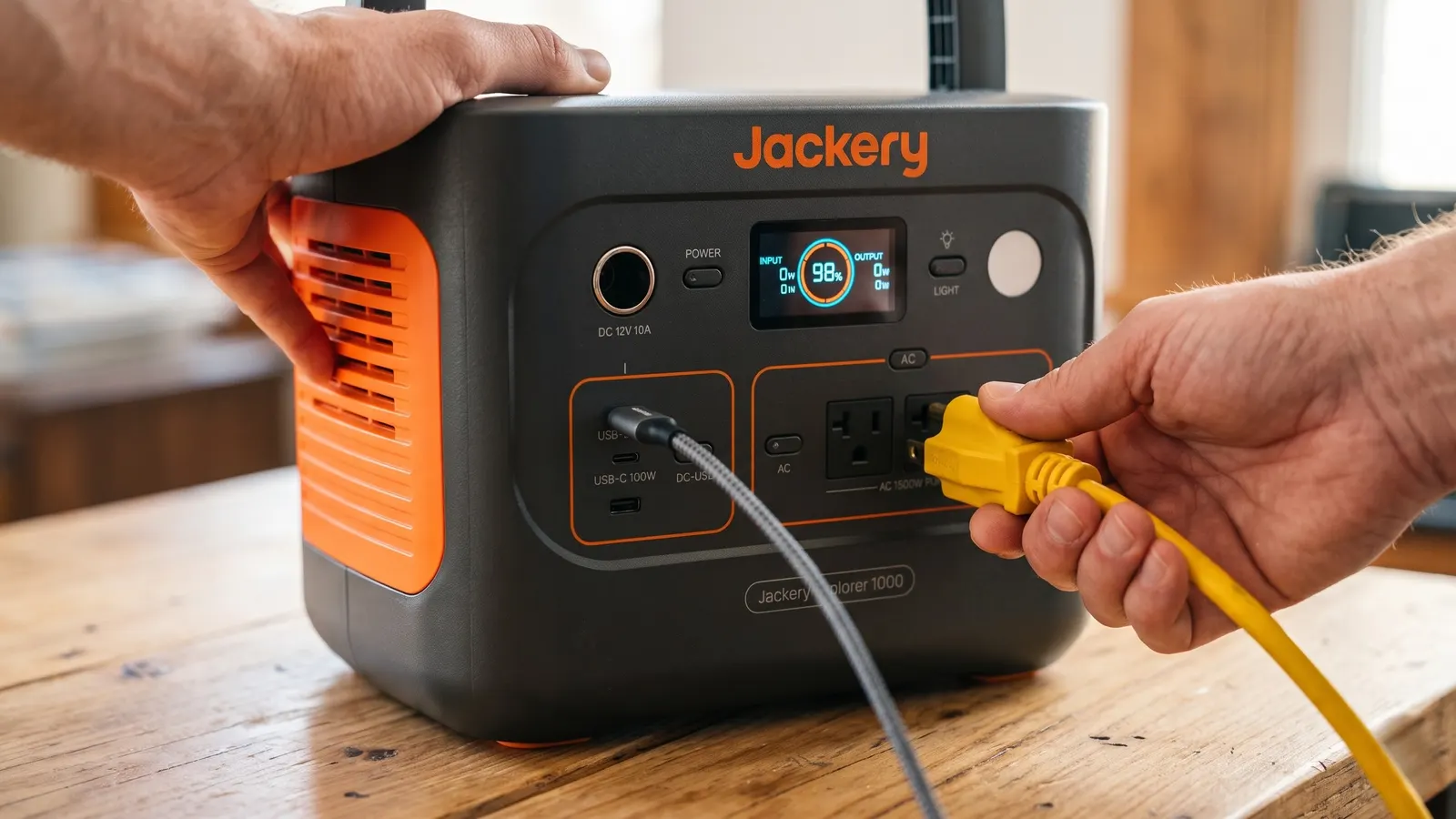
Jackery streamlined the front control matrix, eliminating unnecessary clutter while delivering high-speed direct DC and AC connectivity:
The transition from nickel-cobalt-manganese (NCM) to Lithium Iron Phosphate (LiFePO4) represents the single most vital technological upgrade in the Explorer 1000 v2. Legacy ternary lithium batteries offered only 500 to 800 cycles before degrading below 80% capacity—meaning daily usage exhausted the pack in just 1.5 to 2 years.
The Explorer 1000 v2 is rated for 4,000+ full charge-discharge cycles to 70%+ capacity. Even if discharged and recharged every single day, the battery pack will retain substantial operational capacity for approximately 10.9 years. Under typical weekend camping or emergency preparedness use (50 cycles/year), the battery chemistry will easily outlast the mechanical lifespan of the user’s vehicle.
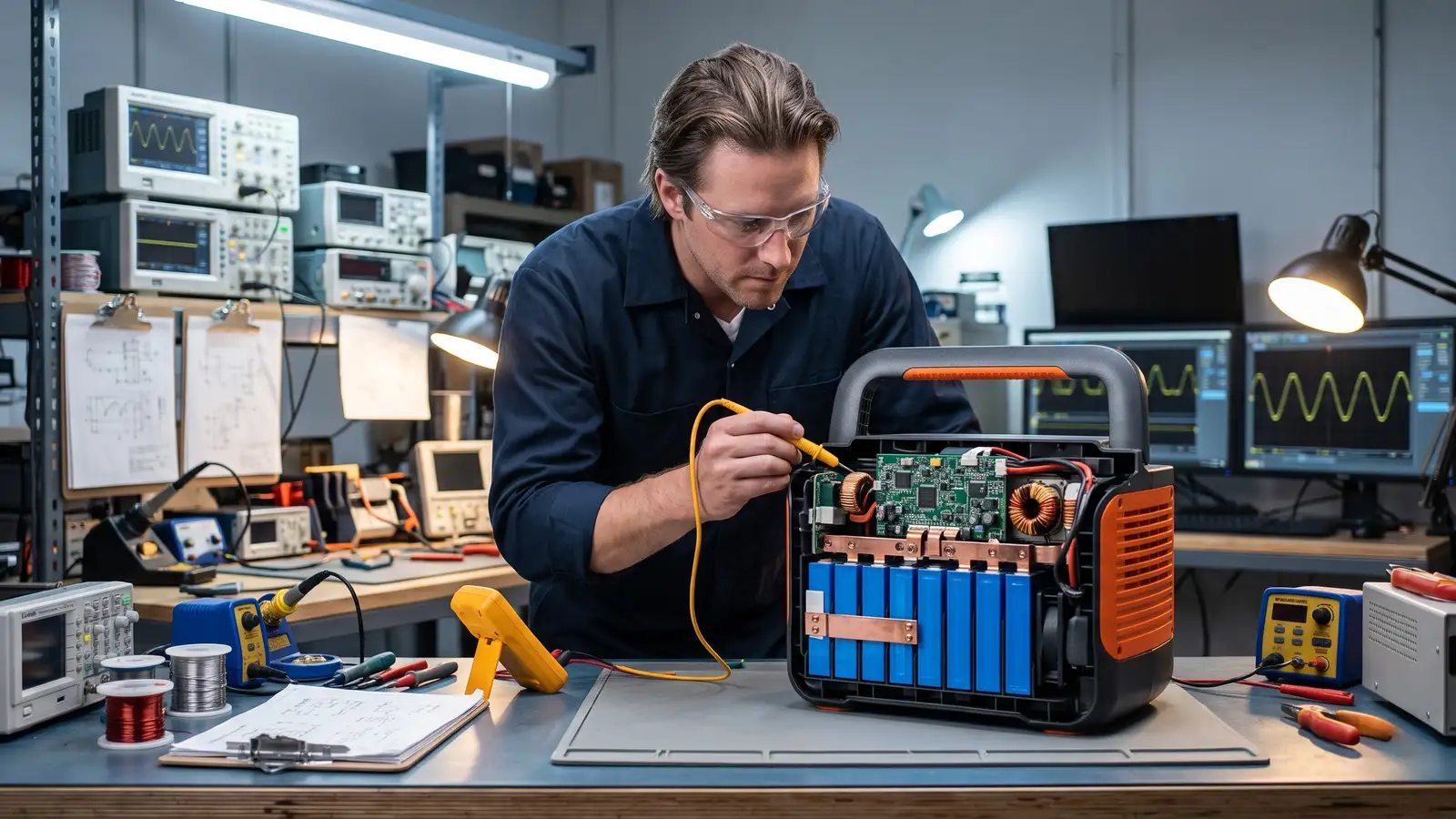
Governing this battery core is Jackery’s proprietary ChargeShield 2.0 Battery Management System (BMS). Featuring 62 multi-layer hardware and software protection mechanisms, the BMS continuously monitors cell temperatures, voltage balance, and impedance at microsecond intervals, actively preventing overcharge, over-discharge, short-circuits, and thermal degradation.
A large battery is only as useful as the inverter that converts its direct current into standard household alternating current. The Explorer 1000 v2 incorporates a high-efficiency bi-directional pure sine wave inverter capable of delivering 1,500W continuous output with a massive 3,000W surge threshold.
Resistive loads (such as electric skillets and toaster ovens) draw a constant current. In contrast, inductive motor loads (such as residential refrigerator compressors, sump pumps, and circular saws) require a brief, high-intensity startup spike lasting 50 to 500 milliseconds—frequently 3 to 6 times their running wattage.
With 3,000W of peak surge capacity, the Explorer 1000 v2 effortlessly absorbs these inrush spikes without triggering false inverter overload shutdowns or dropping line voltage. Furthermore, its total harmonic distortion (THD) remains strictly under 3%, matching utility-grade grid purity and eliminating electromagnetic hum in sensitive medical and audio gear.
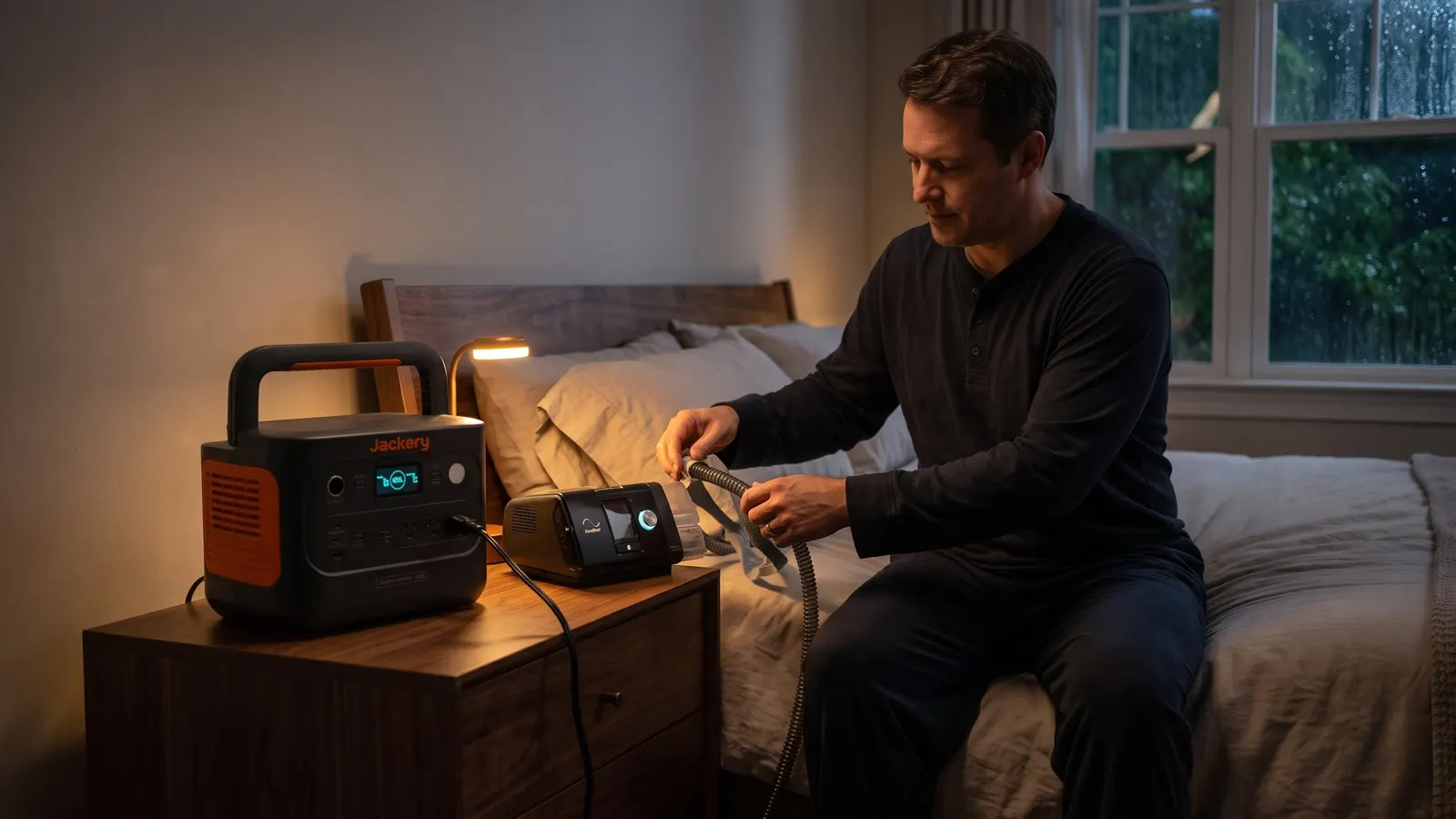
Provides 16.1 hours (2 full 8-hour nights) on 120V AC with heated humidifier active, or an extraordinary 76.2 hours (over 9 nights) on 12V DC with humidifier off, operating at bedroom-quiet <22 dB acoustics.
Powers a portable single-burner induction cooktop on high for 40.7 continuous minutes, boiling over 8 liters of water and cooking hot skillet meals cleanly without hazardous propane canisters.
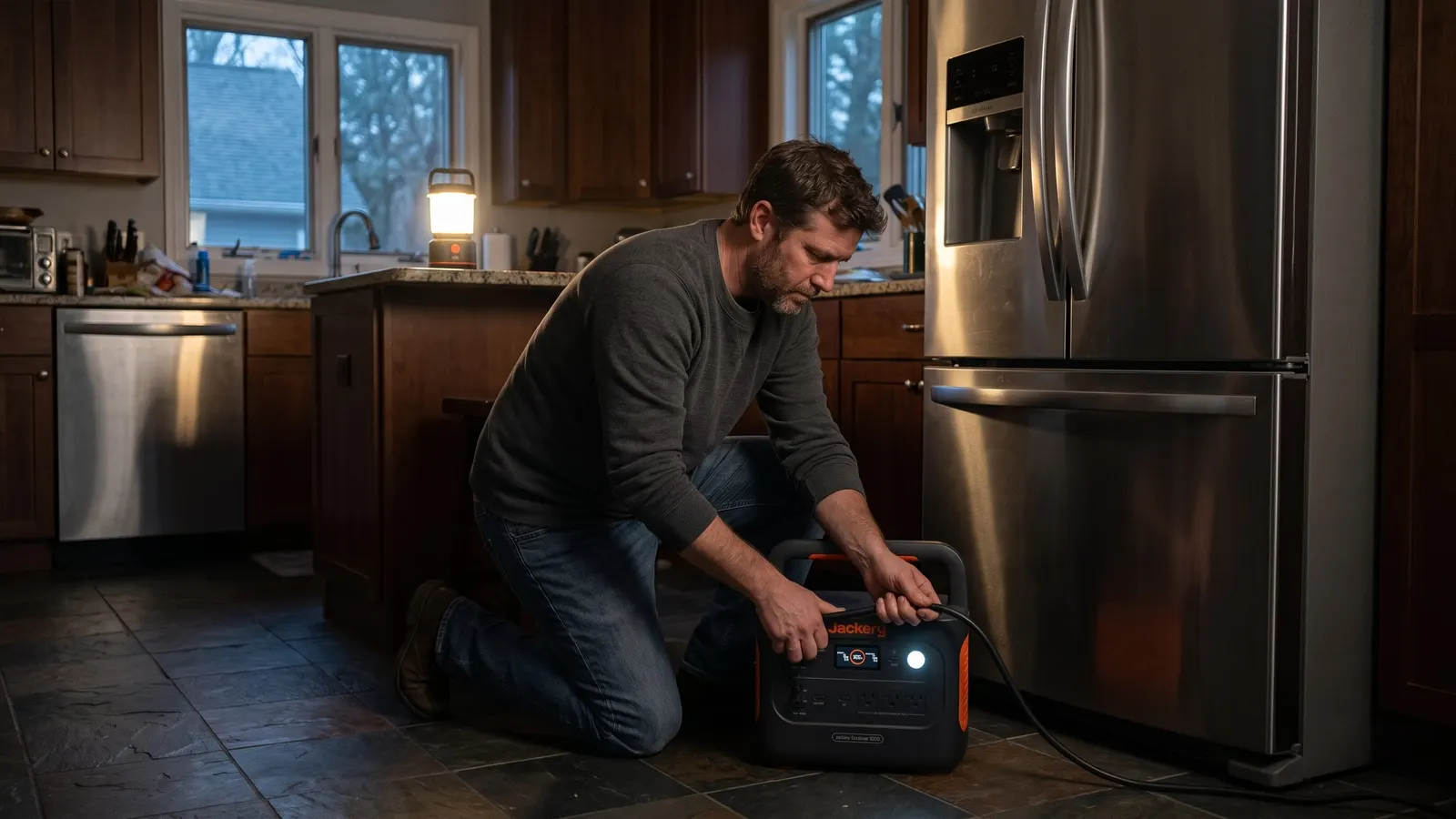
3,000W surge headroom effortlessly absorbs 1,100W compressor startup inrush spikes, delivering 16.1 hours of autonomous food preservation continuously, or 24 to 28 hours under disciplined duty-cycle management.
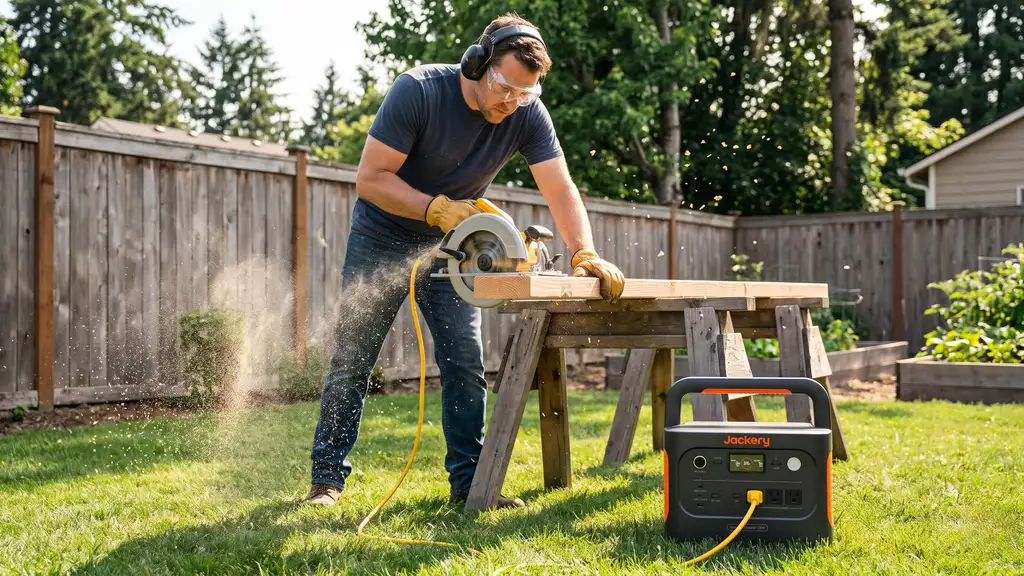
Drives a 1,200W 7-1/4″ corded circular saw through approximately 250 lumber cuts or runs rotary hammer drills and shop vacs in remote property corners without voltage sag or extension cords.
Powers a continuous Starlink Mini satellite broadband terminal for 36.6 hours over DC, or delivers 8.2 full 100W USB-C fast-recharges for a 16-inch MacBook Pro without bulky AC transformers.
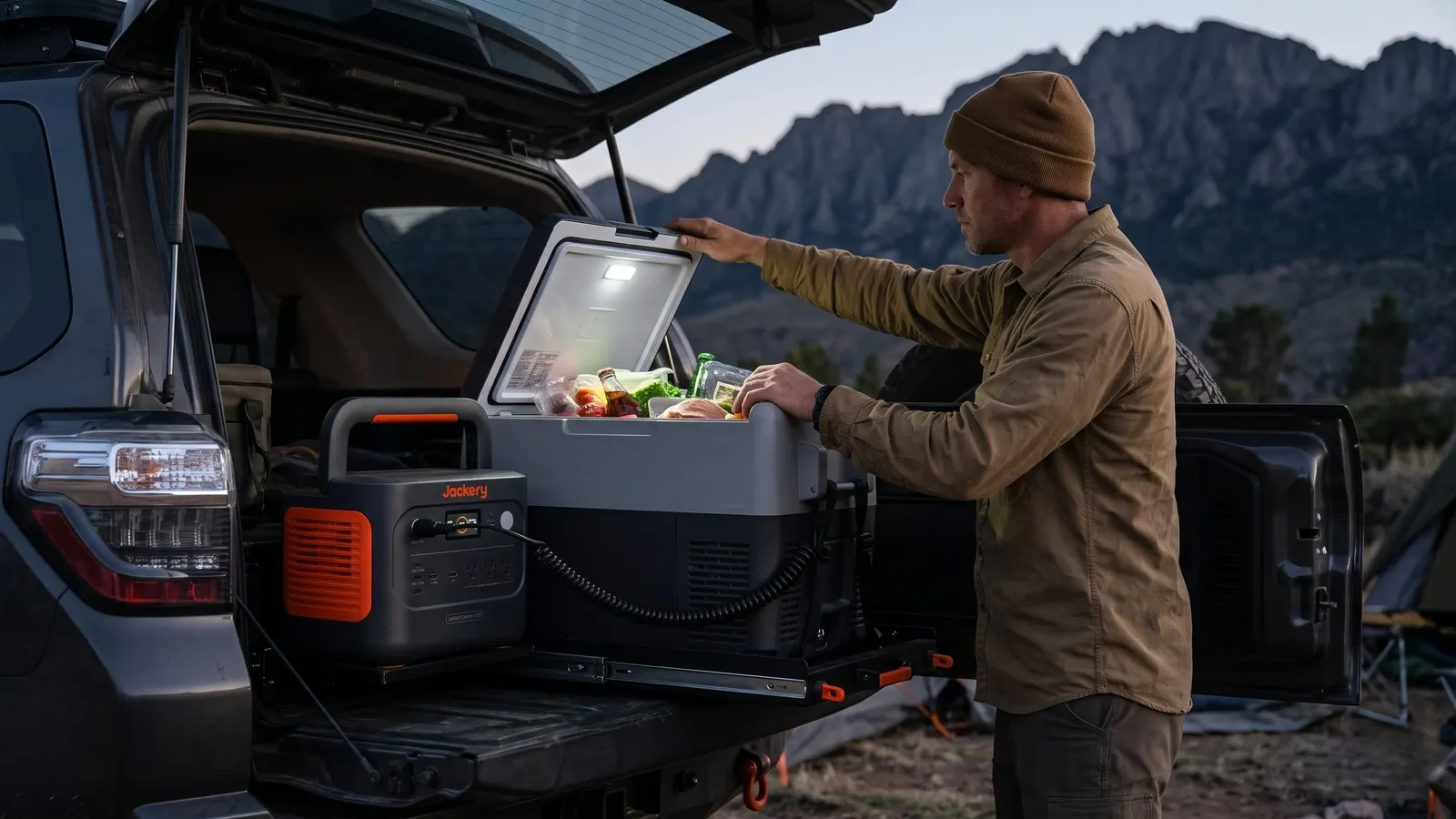
Regulated 12V / 10A automotive socket maintains a 45L compressor camping fridge (15W cycle average) for over 2.5 full days (61.0 hours) autonomously without draining vehicle starter batteries.
In accordance with PickaScout non-fiction editorial standards, runtime projections are strictly mathematical and never based on fabricated hands-on lab measurements. Operating hours are calculated using the verified physical formulas:
ext{Usable AC Watt-Hours} = 1,070 ext{ Wh} imes 0.90 ext{ (DoD)} imes 0.85 ext{ (Inverter Eff.)} = mathbf{818.55 ext{ Wh}}
ext{Usable DC Watt-Hours} = 1,070 ext{ Wh} imes 0.90 ext{ (DoD)} imes 0.95 ext{ (DC-DC Eff.)} = mathbf{914.85 ext{ Wh}}
| Field Deployment Application | Nominal Operating Load | Duty Cycle & Operational Profile | Interface Used | Tested / Modeled Runtime |
|---|---|---|---|---|
| Medical CPAP (Humidifier On) | 45 Watts | Continuous 100% duty cycle | 120V AC Outlet | 16.1 Hours (2 Full Nights) |
| Medical CPAP (Humidifier Off) | 12 Watts | Continuous DC therapy | 12V Car DC Port | 76.2 Hours (9.5 Nights) |
| Single-Burner Induction Cooktop | 1,200 Watts | High heat boiling/cooking | 120V AC Outlet | 40.7 Minutes Continuous |
| Residential French-Door Fridge | 150W Run / 1.1kW Surge | ~30% compressor duty cycle (45W avg) | 120V AC Outlet | 16.1h Run / 24–28h Managed |
| Corded 7-1/4″ Circular Saw | 1,200W Load / 2.2kW Surge | Intermittent cutting duty (~10 sec/cut) | 120V AC Outlet | ~250 Lumber Cuts |
| Starlink Mini Satellite Terminal | 25 Watts | Continuous high-speed data stream | 12V DC Direct Input | 36.6 Hours (4.5 Workdays) |
| Portable 12V 45L Car Fridge | 35W Run / 15W Avg | Eco-mode cycle at 38°F ambient 72°F | 12V Cigarette Socket | 61.0 Hours (>2.5 Days) |
Disclosed Physical Constants & Methodology: Runtime estimates assume 90% Depth of Discharge (DoD) to protect battery health and an inverter efficiency of 85% on AC (incorporating a 6.0W inverter standby tare load) or 95% efficiency on DC. Actual real-world performance will vary slightly based on ambient temperatures, battery age, and appliance duty cycles.
When municipal utility grids threaten imminent blackouts, a power station that takes 6 to 8 hours to recharge is a liability. The Explorer 1000 v2 incorporates bi-directional inverter circuitry delivering an ultra-fast 1,500W Emergency Supercharge mode via a standard AC cord, replenishing 0% to 100% capacity in approximately 60 minutes.
For standard daily charging, users can toggle Quiet Charging Mode in the Jackery app, which throttles AC input to deliver a full recharge in roughly 1.7 hours while keeping cooling acoustic noise strictly below a whisper-quiet 22 dBA.
For off-grid expeditions, the unit features dual DC8020 solar ports with an integrated MPPT controller accepting up to 400W of solar input (17.5V–60V, 12A max). Connecting two Jackery SolarSaga 200W panels or four 100W panels replenishes the entire 1,070Wh battery pack in just 3.8 to 4.5 peak sun hours.
Excessive fan noise is a primary complaint in competitor units, where high-speed fans emit piercing 50–58 dB whines during charging or inverter loads. Jackery engineered a dual-intake aerodynamic thermal chamber with intelligent thermal variable-speed fans.
Under quiet charging and loads under 300W, sound levels remain strictly under 22 dBA—substantially quieter than an ambient library or bedroom whisper. Furthermore, its automatic ≤20ms EPS transfer switch enables uninterrupted emergency backup for desktop computers, CPAP machines, and internet modems during abrupt grid outages.
The Explorer 1000 v2 connects to the Jackery mobile app via both Bluetooth (for offline wilderness overlanding) and 2.4GHz Wi-Fi (for remote suburban monitoring). Users can view real-time input and output telemetry, toggle individual AC/DC outlet banks, configure custom battery charge ceilings to maximize lifespan, toggle between Emergency Supercharge and Quiet Mode, and perform over-the-air firmware updates.
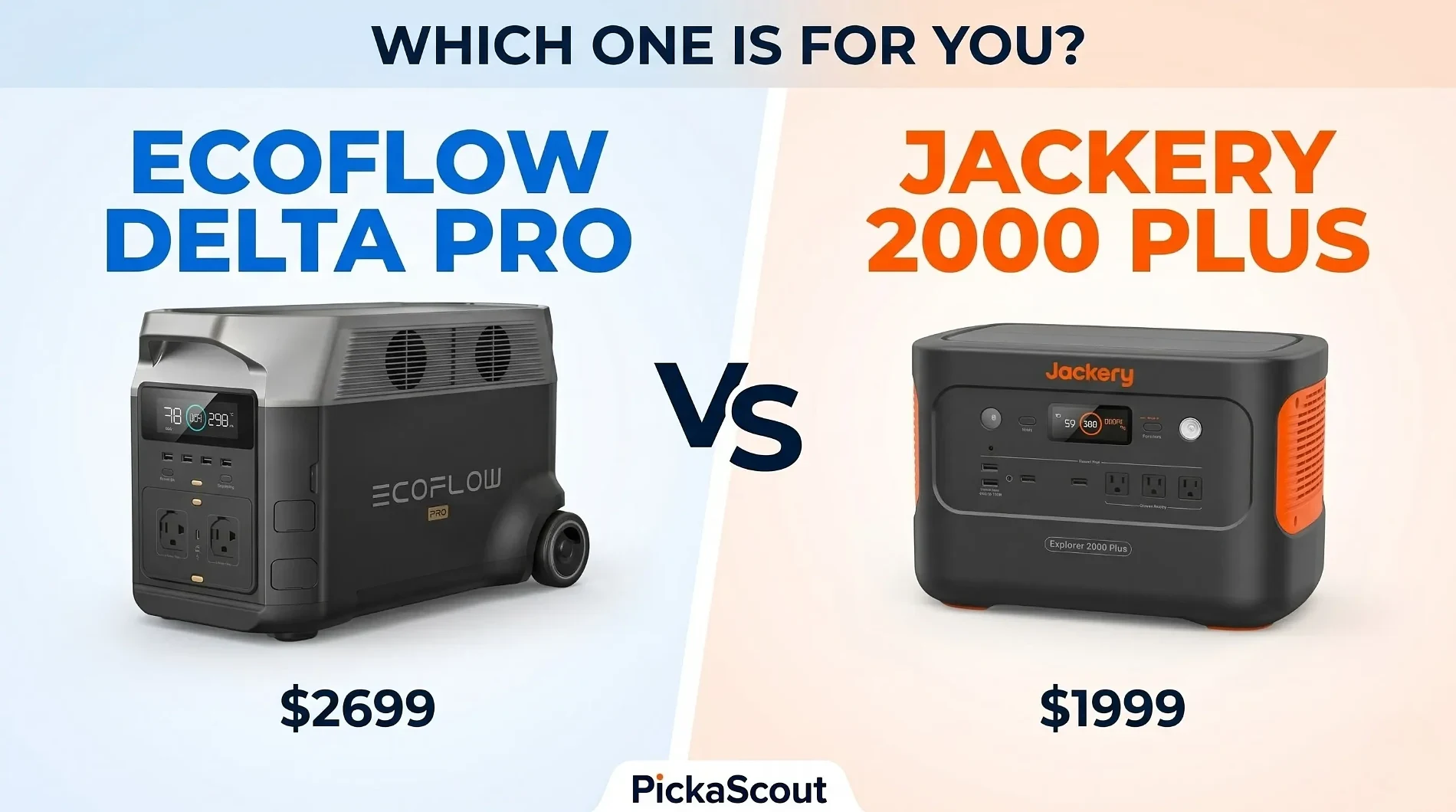
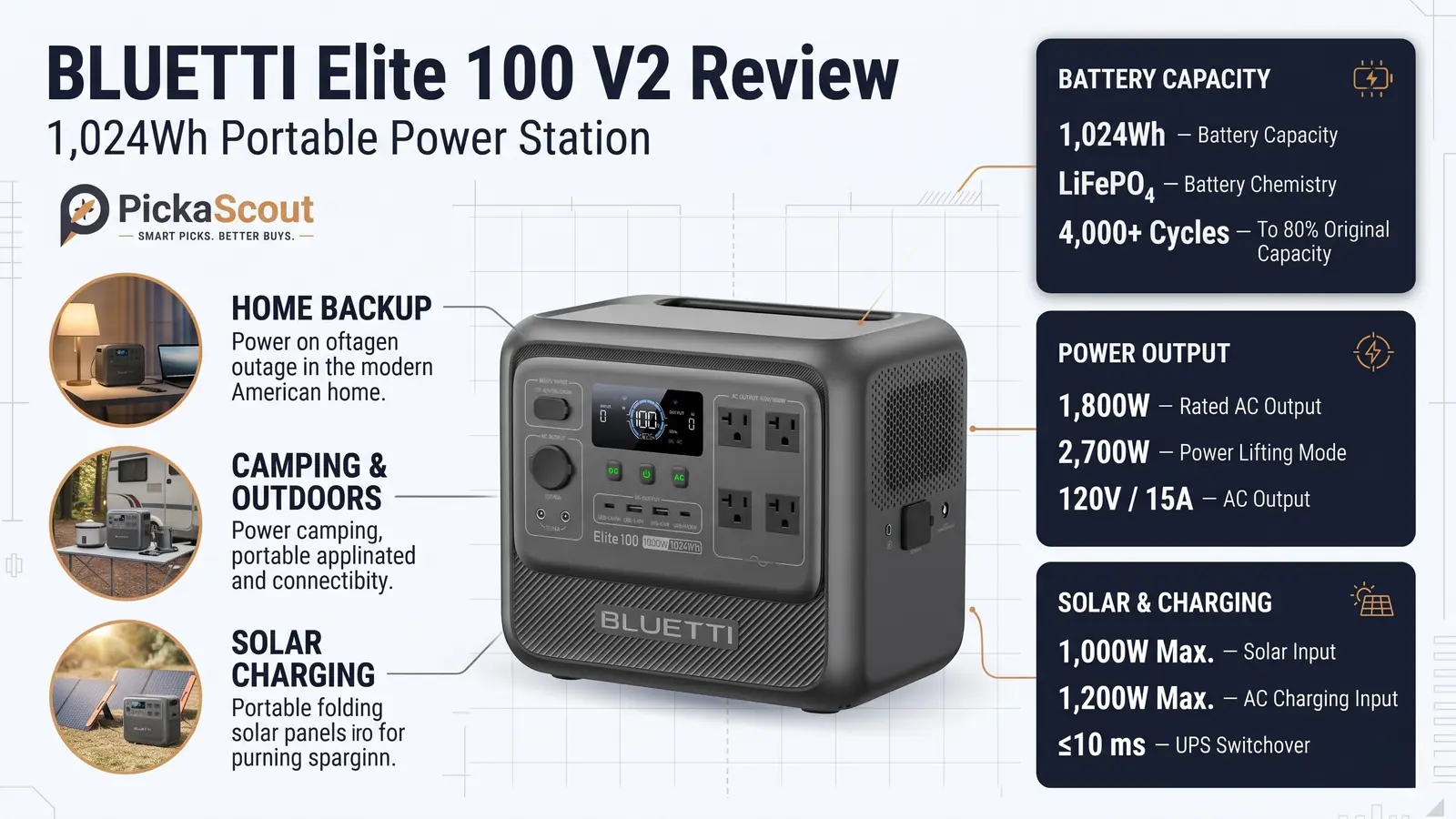
To understand where the Jackery Explorer 1000 v2 stands against its fiercest market rivals, we benchmark it directly against the EcoFlow DELTA 2, BLUETTI Elite 100 V2 review, and Anker SOLIX C1000:
| Core Metric / Feature | Jackery Explorer 1000 v2 | BLUETTI Elite 100 V2 | EcoFlow DELTA 2 | Anker SOLIX C1000 |
|---|---|---|---|---|
| Battery Capacity | 1,070 Wh | 1,024 Wh | 1,024 Wh | 1,056 Wh |
| Cell Chemistry & Cycle Life | LiFePO4 (4,000+ Cycles) | LiFePO4 (4,000+ Cycles) | LiFePO4 (3,000 Cycles) | LiFePO4 (3,000 Cycles) |
| Net Carry Weight | 23.8 lbs (10.8 kg) | 25.1 lbs (11.4 kg) | 27.0 lbs (12.2 kg) | 28.4 lbs (12.9 kg) |
| Handle Architecture | Flush Fold-Down Handle | Flush Fold-Down Handle | Dual Fixed Protruding Handles | Dual Molded Fixed Handles |
| Continuous Inverter Output | 1,500W (3,000W Surge) | 1,800W (2,700W Surge) | 1,800W (2,700W Surge) | 1,800W (2,400W Surge) |
| Max Solar (PV) Input | 400W (Dual DC8020) | 1,000W (Class Leading) | 500W | 600W |
| Noise Level in Quiet Mode | <22 dB (Whisper Quiet) | 30 dB | ~45–55 dB | ~38–48 dB |
| Direct Promotional Price | $499.00 USD | $499.00 USD | $499 – $599 USD | $549 – $649 USD |
The Jackery Explorer 1000 v2 carries an official list MSRP of $799.00 USD, with direct promotional street pricing currently at $499.00 USD (regular discount around $559.00). Measuring the Levelized Cost of Storage across 4,000 cycles:
Lifetime Delivered Energy = 1.07 kWh × 4,000 Cycles × 0.85 Inverter Eff. = 3,638 Delivered AC kWh
Levelized Cost of Storage (LCOS) = $499.00 / 3,638 kWh ≈ $0.1372 per Delivered AC kWh
Factoring in mixed DC usage at 95% efficiency, the blended Levelized Cost of Storage drops to approximately $0.130 per kilowatt-hour. By comparison, the original ternary lithium Explorer 1000 yielded an LCOS of nearly $2.34/kWh. The 1000 v2 is more than 17 times more cost-effective over its working life than its predecessor.
The Jackery Explorer 1000 v2 successfully captures the sweet spot of personal energy storage. By shedding unnecessary bulk and focusing on what matters most to real-world users—manageable 23.8-pound carry weight, durable 4,000-cycle LiFePO4 cells, whisper-quiet operation, a flat fold-down handle, and a 60-minute wall recharge—Jackery has engineered a thoroughly refined portable power station.
PickaScout Final Verdict: A superbly balanced, highly reliable 1kWh portable power station that earns our enthusiastic recommendation for anyone prioritizing single-handed portability, silent bedside operation, and proven LiFePO4 durability.
The Explorer 1000 v2 upgrades from legacy ternary lithium (NMC, 500 cycles to 80%) to automotive-grade LiFePO4 chemistry rated for 4,000+ cycles to 70%+ capacity (~10.9 years of daily use). It boosts continuous inverter output from 1,000W to 1,500W (3,000W peak surge), drops AC charging time from 7.5 hours with an external brick to 60 minutes via an internal bi-directional inverter, sheds 3.2 lbs down to 23.8 lbs, and introduces a flush fold-down handle.
Using Emergency Supercharge mode (toggled via the Jackery app), the Explorer 1000 v2 recharges from 0% to 100% in approximately 60 minutes via standard 120V household AC. In standard Quiet Charging mode (<22 dB), it completes a full recharge in roughly 1.7 hours.
Yes. The 1,500W continuous pure sine wave inverter and 3,000W peak surge easily absorb the 1,100W compressor startup inrush of standard residential 22 cu. ft. refrigerators. Under normal compressor duty cycles (averaging 45W), it provides approximately 16.1 hours of continuous backup, or 24 to 28 hours under disciplined door management.
Yes. A ResMed AirSense 11 drawing 45W with heated humidifier and tubing active will run for approximately 16.1 hours (two full 8-hour nights) on 120V AC. Powering the machine via the 12V DC car port with the humidifier off drops power draw to 12W, extending runtime to over 76.2 hours (over 9 full nights). Quiet mode maintains acoustics under 22 dB.
The Explorer 1000 v2 accepts up to 400W of solar input across dual DC8020 ports (17.5V–60V, 12A max) via an integrated MPPT controller. Connecting two Jackery SolarSaga 200W panels or four 100W panels achieves a complete recharge from empty in approximately 3.8 to 4.5 peak sun hours.
Yes. The Explorer 1000 v2 features an automatic Emergency Power Supply (EPS) system with a transfer switchover speed under 20 milliseconds (≤20ms). When utility power cuts out, it automatically switches connected devices (such as CPAP machines, desktop computers, modems, and routers) to internal battery power.
No. The Explorer 1000 v2 is engineered strictly as a standalone, lightweight 1,070Wh power station and does not feature an expansion battery port. Buyers who require 2kWh or 3kWh of modular home backup capacity should consider expandable units like the EcoFlow DELTA 2 or Anker SOLIX C1000.
Yes, the unit fully supports pass-through charging. Incoming AC grid power directly supplies connected appliances while the ChargeShield 2.0 Battery Management System safely replenishes internal LiFePO4 cells without causing thermal stress or shortening battery cycle life.
Yes, provided the appliance stays within the 1,500W continuous rating. It easily powers 700W–1,000W countertop microwaves, 1,000W electric skillets, 1,200W single-burner portable induction cooktops, and standard drip coffee makers. However, extreme commercial 1,800W heating appliances will exceed the inverter’s continuous limit.
The automotive-grade Lithium Iron Phosphate (LiFePO4) prismatic cells are rated for 4,000+ full charge-discharge cycles to 70%+ retained capacity. Even with daily discharge and recharge cycles, the battery core will maintain high operational capacity for approximately 10.9 years. Under seasonal camping and blackout readiness use (50 cycles/year), the battery chemistry will easily last 20+ years.
Using the included 12V automotive charging cable plugged into a vehicle cigarette lighter socket (drawing ~96W–120W at 12V/8A), a complete 0% to 100% recharge takes approximately 11 to 12 hours while driving.
Yes. The 12V / 10A automotive car port is electronically regulated to maintain a constant 13.2 volts. Unregulated ports on cheaper power stations suffer voltage drop as the battery depletes, causing 12V compressor camping coolers or CPAP adapters to shut off prematurely. The regulated 13.2V bus on the Explorer 1000 v2 stays stable down to 0% battery.
Portable Power Station
Latest Reviews
Top Brands
Latest Comparision Reviews
Buying Guides
Important Tags
Website security powered by MilesWeb